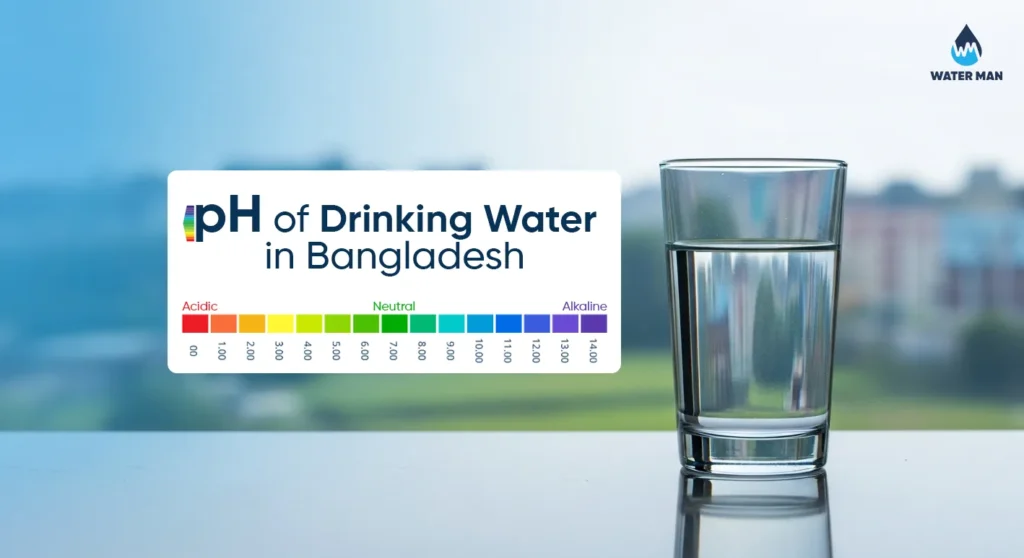
When people think about water quality in Bangladesh, they usually focus on TDS, iron, or arsenic. However, one of the most fundamental yet overlooked parameters is pH of drinking water in BD. pH determines whether water is acidic or alkaline, and it directly affects:
- Water safety
- Taste and smell
- Pipe corrosion
- Effectiveness of filtration systems
Even though pH may not always directly harm the body, it plays a critical role in overall water quality and contamination behavior.
What is pH in Drinking Water?
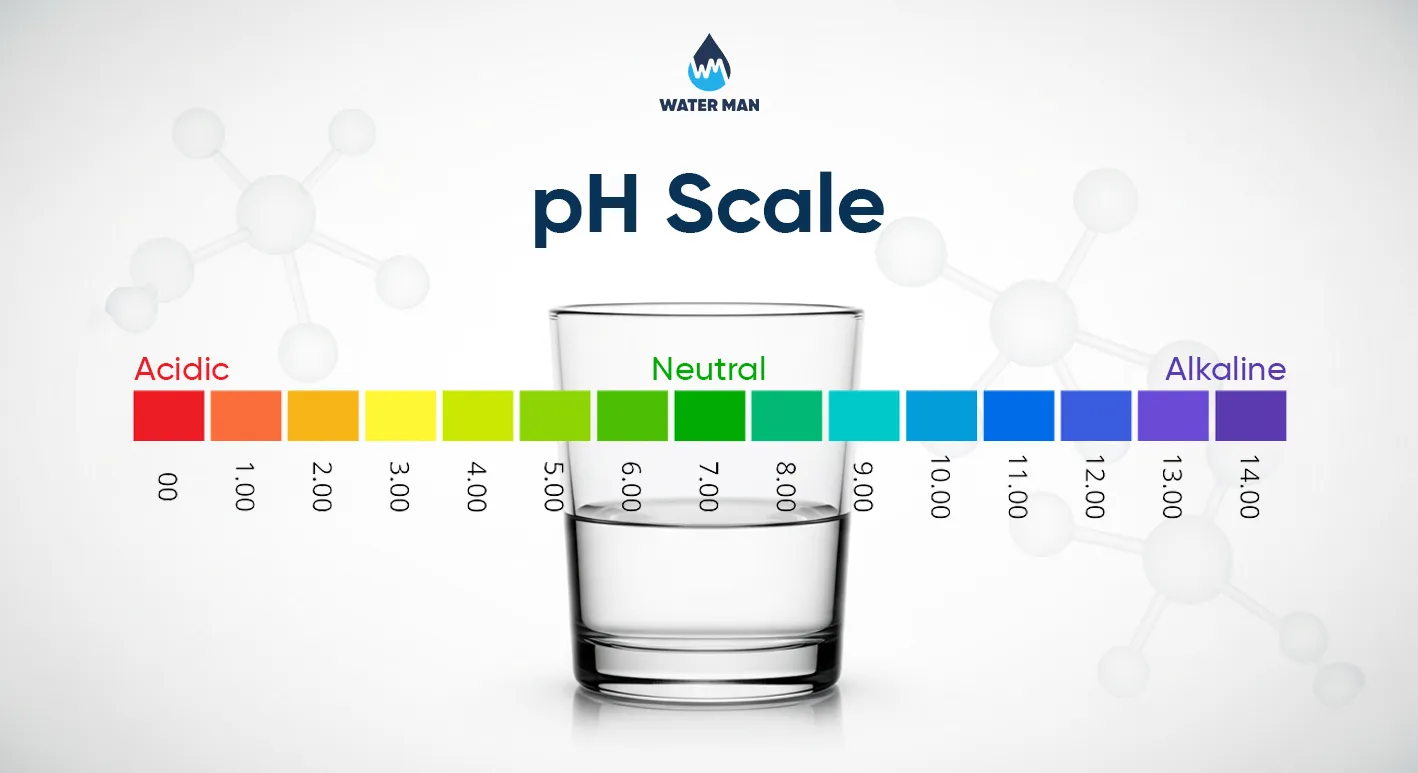
pH is a scale from 0 to 14 that measures how acidic or alkaline water is:
- pH < 7 → Acidic
- pH = 7 → Neutral
- pH > 7 → Alkaline
Pure water has a neutral pH of 7, but drinking water usually varies depending on minerals, chemicals, and environmental conditions.
Safe pH Level for Drinking Water (WHO & Bangladesh Standard)
According to the World Health Organization (WHO) and BSTI, pH is considered an operational parameter rather than a direct health concern. Still, it plays a critical role in water treatment efficiency and overall water quality. According to international and national guidelines:
- Safe range: 6.5 – 8.5 pH of drinking water in BD
- Acceptable extended range: up to 9.5 in some cases
Ideal pH for Drinking Water
- Around 7.0 – 7.5 is considered optimal for taste and balance
Studies in Bangladesh show that most groundwater falls between 6.7 and 8.3, which is generally within acceptable limits, but it can be contaminated with iron, hardness, viruses, bacteria, heavy metals, etc.
pH of Drinking Water in Bangladesh: Real Scenario
What Research Shows
- Most tube well water is slightly alkaline
- Urban water (Dhaka) ranges roughly 6.6 to 8.2
- Bottled and Jar water typically ranges from 6.3 to 7.7
Key Insight (Expert View)
pH is usually within safe limits in Bangladesh, BUT the real issue is: High iron, Arsenic, salinity, Bacteria, Virus, water line contamination, etc.
These contaminants are affected by pH, making it a critical control parameter.
Why pH Is Important for Drinking Water
1. Controls Chemical Behavior
pH determines how contaminants behave:
- Low pH → increases heavy metal solubility
- High pH → affects chemical reactions and scaling
2. Affects Water Treatment Efficiency
For example:
- Chlorine disinfection works best at a pH below 8
- RO and filtration efficiency vary with pH
3. Protects Plumbing System
- Acidic water → pipe corrosion
- Alkaline water → scaling and blockage
Health Effects of pH Imbalance
Does pH Directly Affect Health?
According to scientific studies, pH itself has no direct major health impact in normal ranges. However, indirect effects are very important.
Effects of Low pH (Acidic Water)
- Metallic taste
- Pipe corrosion
- Release of harmful metals (lead, copper)
- Skin irritation (in extreme cases)
Effects of High pH (Alkaline Water)
- Bitter or soda-like taste
- Scale formation
- Reduced effectiveness of disinfection
- Possible digestive discomfort (in extreme cases)
Common Causes of pH Imbalance in Bangladesh
1. Geological Factors: Soil and rock minerals (calcium, magnesium)
2. Industrial Pollution: Chemical discharge affects water chemistry
3. High TDS and Minerals: Directly influences alkalinity
4. Poor Water Treatment: Lack of proper filtration or balancing
How to Test pH of Drinking Water

1. pH Meter (Easy & Convenient)
- Digital device
- Used by professionals
2. Test Strips (Easy & Cheap)
- Color-based result
- Good for home use
3. Laboratory Testing (Most Accurate)
- Most reliable
- Recommended for full analysis
How to Fix pH Problems in Drinking Water
For Low pH (Acidic Water)
- Use alkaline filters or remineralization filters
- Add mineral cartridges
- Install calcite filters
For High pH (Alkaline Water)
- Use RO (Reverse Osmosis) systems
- Activated carbon filtration
- Chemical balancing (for industrial use)
Expert Recommendations for Bangladesh Households
Based on field experience and research:
- Test Your Water First: Never assume water quality.
- Don’t Focus on pH Alone: pH is important—but iron, arsenic, and bacteria are bigger risks.
- Use a proper filtration system: Choose based on: TDS level, Iron presence, Microbial contamination
- Maintain Regular Servicing: Unmaintained filters can change pH and reduce water quality.
Common Myths About Water pH (Debunked with Expert Insights)
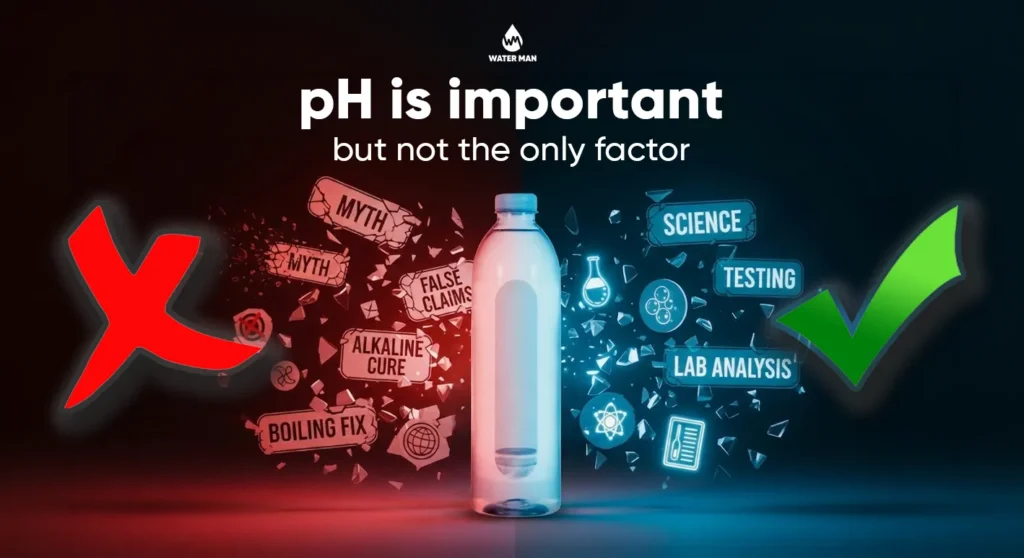
Despite growing awareness, many misconceptions about the pH of drinking water still exist, especially due to marketing claims and misinformation. Let’s break down the most common myths with a scientific perspective and expert insights.
Myth 1: Alkaline Water Is Always Healthier ❌
Reality: There is no strong clinical evidence that alkaline water provides significant health benefits for healthy individuals.
Expert Insight:
- The human body tightly regulates blood pH at around 7.35–7.45, regardless of what you drink
- According to health research reviews, diet or water has minimal impact on blood pH balance
Most benefits of alkaline water are related to hydration or mineral content, not pH itself.
Myth 2: Drinking Water Can Change Your Body’s pH ❌
Reality: This is one of the most common myths.
Expert Insight:
- Your body maintains pH balance using:
- Kidneys
- Lungs
- Even if you drink acidic or alkaline water, your body quickly neutralizes it
Only extreme medical conditions can change blood pH not drinking water.
Myth 3: Low pH (Acidic Water) Is Always Dangerous ❌
Reality: Slightly acidic water (e.g., pH 6–6.5) is not directly harmful to health.
Expert Insight:
- The real risk of low pH is indirect:
- Corrosion of pipes
- Release of metals like lead and copper
So the danger is not the pH itself, but what it causes in the system.
Myth 4: High pH Water Is Always Safe ❌
Reality: Water with very high pH (>9) can cause issues.
Expert Insight:
- High pH water:
- Reduces chlorine disinfection efficiency
- Causes scaling in pipes
- Can create unpleasant taste
Extremely high pH can also indicate chemical imbalance in water.
Myth 5: pH Alone Determines Water Quality ❌
Reality: pH is only one parameter of water quality.
Expert Insight:
In Bangladesh, water may have:
- Safe pH
- But still contain arsenic, iron, bacteria, or high TDS
Many unsafe water sources in Bangladesh have normal pH levels but harmful contaminants.
Myth 6: Boiling Water Fixes pH Problems ❌
Reality: Boiling water does NOT significantly change pH in a useful way.
Expert Insight:
- Boiling kills bacteria
- But does NOT remove:
- Dissolved salts
- Heavy metals
- Arsenic
In some cases, boiling can even slightly increase mineral concentration due to evaporation.
Myth 7: RO Water Is Too Acidic and Unsafe ❌
Reality: RO water can have slightly lower pH, but it is safe when properly maintained.
Expert Insight:
- RO removes dissolved minerals, which can reduce pH slightly
- Modern systems often include:
- Mineral cartridges
- pH balancing filters / Alkaline cartridges
Properly configured RO systems produce safe and balanced drinking water.
Myth 8: Higher pH Means Better Water Quality ❌
Reality: Higher pH does NOT mean better water.
Expert Insight:
- Ideal drinking water pH: 6.5 – 8.5
- Very high pH may indicate:
- Chemical contamination
- Poor treatment balance
“More alkaline” does NOT equal “more healthy.”
Key Takeaway from Experts
- pH is important but not the only factor
- Safe drinking water depends on:
- Proper filtration
- Contaminant removal
- Regular maintenance
The smartest approach is to test water and treat based on actual contamination, not myths.
Why Choose WaterMan BD for Water Quality Solutions
Understanding pH is just the first step solving water problems requires professional expertise.
WaterMan BD provides:
- Free water quality testing (including pH analysis)
- Customized filtration solutions
- RO systems with pH balancing
- Installation and maintenance support
- 26+ years of industry experience
- 15+ team of expert technicians
This ensures safe, balanced, and high-quality drinking water for homes and businesses in Bangladesh.
Conclusion: The Right pH Means Better Water Quality
In Bangladesh, drinking water pH is usually within safe limits, but it still plays a critical role in water safety and treatment effectiveness.
The key takeaway:
- Maintain pH between 6.5 – 8.5
- Always test water
- Focus on overall water quality not just pH
Safe water is not just about clarity it’s about balance, treatment, and proper maintenance.
References
International Standards & Guidelines
- World Health Organization (WHO).
Guidelines for Drinking-water Quality, 4th Edition (2022 update).
Available at: WHO Drinking Water Guidelines - World Health Organization (WHO).
Guidelines for Drinking-water Quality, 4th Edition (2021 chapters).
Available at: WHO Guidelines Chapters - World Health Organization (WHO).
pH in Drinking Water – Background Document for Guidelines. - World Health Organization (WHO).
Arsenic in Drinking Water – Background Document. - World Health Organization (WHO).
Developing Drinking Water Quality Regulations and Standards (2018). - World Health Organization (WHO). History of pH Guidelines in Drinking Water