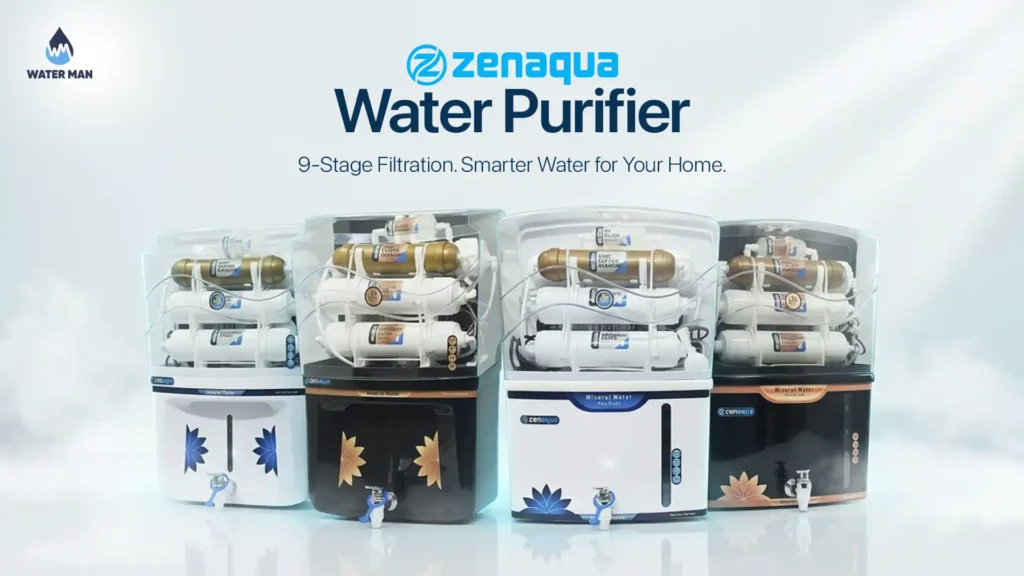
Zen Aqua water purifier in Bangladesh is an option for households looking for a multi-stage water purification system with RO, UV, UF, Zinc, Copper and Alkaline filtration technologies. With a stated 100 GPD production capacity, a 12-litre maximum storage tank and nine filtration stages, the Zen Aqua Grand+ and Zen Aqua Smart models offer a practical configuration for everyday household water purification.
Available in Grand+ and Smart designs, with Black and White appearance options, this water purifier range combines multiple filtration technologies in one system. The technical specifications are the same across the variants described here, so choosing between them mainly comes down to the preferred appearance and the available model configuration.
Whether you are researching a 9-stage water purifier for your family or comparing RO water purifiers before making a purchase, understanding the filtration process, storage capacity and maintenance requirements can help you make a more informed decision.
What Is the Zen Aqua Water Purifier?
The Zen Aqua water purifier is a multi-stage reverse osmosis (RO) purification system designed for household use. Its stated configuration includes nine stages: an outer PP filter, an inline sediment filter, an inline post-carbon filter, an RO membrane, UV, UF, Zinc, Copper and Alkaline filtration.
Each component serves a different role in the overall treatment process. The RO membrane is the main membrane-based purification component, while the other stages provide additional filtration or treatment functions within the system.
The Zen Aqua Grand+ and Zen Aqua Smart models share the same specifications according to the product information provided. Customers can choose between the Grand+ and Smart designs and the Black or White appearance options without treating them as different purification configurations.
For households comparing a home water purifier in Bangladesh, the important considerations are the source water quality, daily water demand, available installation space and the manufacturer’s recommended maintenance schedule.
Key Specifications of Zen Aqua Grand+ and Zen Aqua Smart
The following specifications apply to the models described in this guide.
| Specification | Details |
| Brand | Zen Aqua |
| Models | Grand+ and Smart |
| Appearance options | Black and White |
| Origin | India |
| Made in | India |
| Purification technology | Reverse Osmosis (RO) |
| Total purification stages | 9 stages |
| RO membrane | HI-L membrane, described as USA technology |
| Stated production capacity | 100 GPD |
| Stated hourly production | Approximately 15 litres per hour |
| Maximum reserve tank capacity | 12 litres |
| Stated family suitability | 1–12 persons |
| Additional filtration stages | UV, UF, Zinc, Copper and Alkaline |
Actual water output may vary depending on incoming water pressure, temperature, feed-water TDS, membrane condition and the overall operating condition of the unit. The stated family suitability should also be considered alongside actual daily consumption.
Understanding the 9-Stage Water Purification System
The nine-stage configuration is one of the main features of the Zen Aqua RO water purifier. Understanding what each stage does can help buyers evaluate how the system fits their household’s water treatment needs.
Stage 1: Outer PP Filter
The outer polypropylene (PP) filter serves as an initial filtration stage. It is intended to capture suspended particles and visible impurities, helping reduce the particulate load reaching the subsequent filters.
Stage 2: Inline Sediment Filter
The inline sediment filter provides another layer of particulate filtration. Its role is to help capture sediment and suspended material that may remain in the incoming water.
The service life of this filter depends on the quality of the source water and the amount of sediment entering the system.
Stage 3: Inline Post-Carbon Filter
The product specification lists an inline post-carbon filter as the third stage. Carbon filtration is commonly used in water treatment to reduce certain taste- and odour-related compounds, depending on the filter media and water conditions.
The exact treatment performance depends on the filter design and the manufacturer’s specifications.
Stage 4: RO Membrane Filter
Reverse osmosis is the core membrane-based purification stage of the Zen Aqua system. An RO membrane can reduce many dissolved substances and other contaminants, depending on the membrane’s performance and the characteristics of the incoming water.
RO performance is influenced by feed-water pressure, temperature, TDS and membrane condition. A water test and appropriate maintenance are important for assessing the suitability of an RO system for a particular water source.
Stage 5: UV Filter
Ultraviolet (UV) treatment is used to inactivate susceptible microorganisms when the system is designed and operated correctly. Its effectiveness depends on factors such as UV intensity, water clarity, exposure conditions and lamp condition.
UV treatment should not be treated as a substitute for proper maintenance or as a guarantee that every possible contaminant has been removed.
Stage 6: UF Filter
Ultrafiltration (UF) uses a membrane barrier to retain certain suspended particles and microorganisms, depending on the membrane’s specifications.
The UF stage provides an additional filtration component in the overall system. Its exact contribution depends on the unit’s design and the condition of the membrane.
Stage 7: Zinc Filter
The Zen Aqua configuration includes a Zinc filter. The performance and function of this stage depend on the media used and the manufacturer’s design.
Buyers who want to understand mineral addition or the resulting water composition should consult the manufacturer’s technical information rather than assume a specific mineral concentration.
Stage 8: Copper Filter
The Copper filter is another listed component of the system. Its actual contribution to the treated water depends on the filter media, design and operating conditions.
The presence of a Copper filter alone does not establish a particular health benefit or guarantee a specific copper concentration in the output water.
Stage 9: Alkaline Filter
The final listed stage is an Alkaline filter. Such filters are designed to influence the treated water’s properties, potentially including pH, depending on their media and configuration.
The actual output pH and mineral composition can only be established through suitable testing. An alkaline label should not be interpreted as proof of a medical benefit.
Together, these nine stages form the specified treatment configuration. However, the number of stages alone does not determine overall purification performance. Source-water testing, component quality, installation and regular servicing remain important.
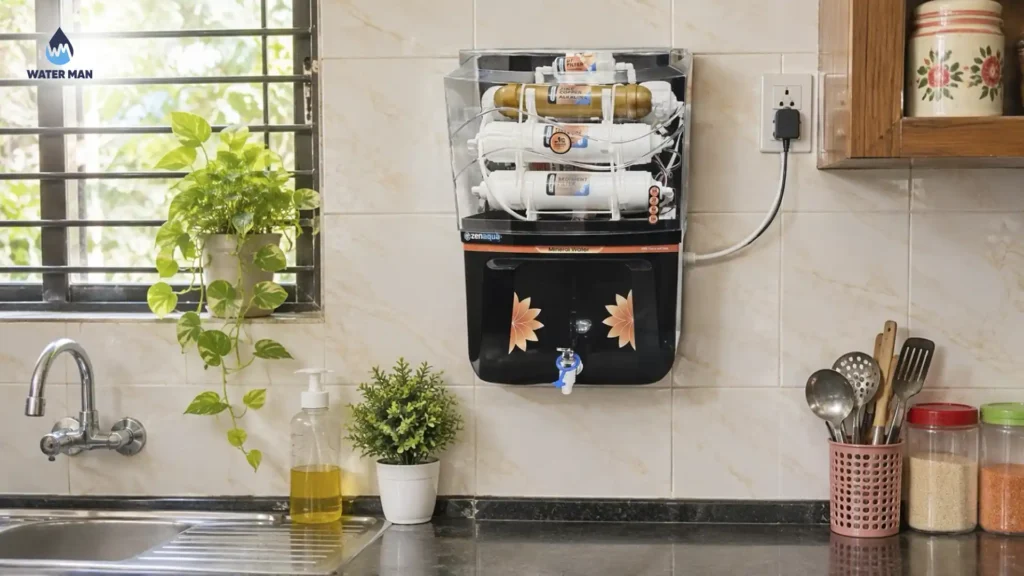
Zen Aqua Grand+ vs Zen Aqua Smart: Which Design Should You Choose?
The Zen Aqua Grand+ and Zen Aqua Smart are two design options in the product range described in this guide. Both are specified with the same nine-stage purification configuration, 100 GPD stated capacity, approximately 15 litres per hour stated production and a maximum 12-litre reserve tank.
The Black and White appearance options allow customers to choose a finish that better suits their kitchen or installation area.
When comparing the Grand+ and Smart versions, focus on the design you prefer and confirm the exact model and colour available before ordering. Since the specifications provided are the same, there is no need to assume that one version has better filtration performance simply because its external appearance differs.
For buyers comparing water purifiers for home use, the more important technical questions are whether the system matches the source-water conditions, whether its output meets household demand and whether replacement filters and servicing are available.
Is a 100 GPD Water Purifier Suitable for Your Family?
The Zen Aqua range is specified at 100 GPD, with a stated production rate of approximately 15 litres per hour. GPD means gallons per day, a nominal capacity rating used for RO membranes and water purification systems. Actual production under household conditions may differ from the nominal rating.
The supplied product details list the system as suitable for families of 1–12 persons. Nevertheless, the right capacity depends on how much purified water your household consumes each day.
Consider the following factors before selecting a water purifier:
- Daily drinking-water demand: Estimate how much water your household uses for drinking and food preparation.
- Storage needs: The maximum reserve tank capacity is stated as 12 litres. Actual usable water may differ from the nominal tank capacity.
- Source-water quality: High TDS, hardness, iron or other source-water issues may affect the suitability and maintenance requirements of a system.
- Installation space: Check the available area, water connections, drainage requirements and electrical supply.
- Servicing access: Make sure the unit can be inspected and serviced when filters or other components require attention.
If you are unsure which purification system suits your water source, arrange an appropriate water-quality test before making a final decision.
Maintenance Tips for Long-Term Performance
Even a multi-stage water purifier requires regular maintenance. Filter replacement intervals vary according to incoming water quality, usage and the manufacturer’s recommendations.
Follow these practical steps to maintain your Zen Aqua water purifier:
- Follow the recommended filter replacement schedule. Do not rely only on appearance to judge whether a filter is still effective.
- Monitor water output. A noticeable reduction in production may indicate a filter restriction, pressure issue or membrane-related problem.
- Arrange periodic servicing. Have the system checked according to the manufacturer’s guidance, including its RO membrane, UV component, connections and other stages.
- Maintain hygienic storage. Keep the dispensing area clean and follow the recommended procedure for tank sanitation.
- Check the treated water when needed. Suitable water testing can help assess relevant parameters and identify changes in performance.
- Use compatible replacement parts. Incorrect filters or components can affect the system’s operation.
Maintenance is especially important for systems using multiple filtration stages because each component has its own function and service requirements.
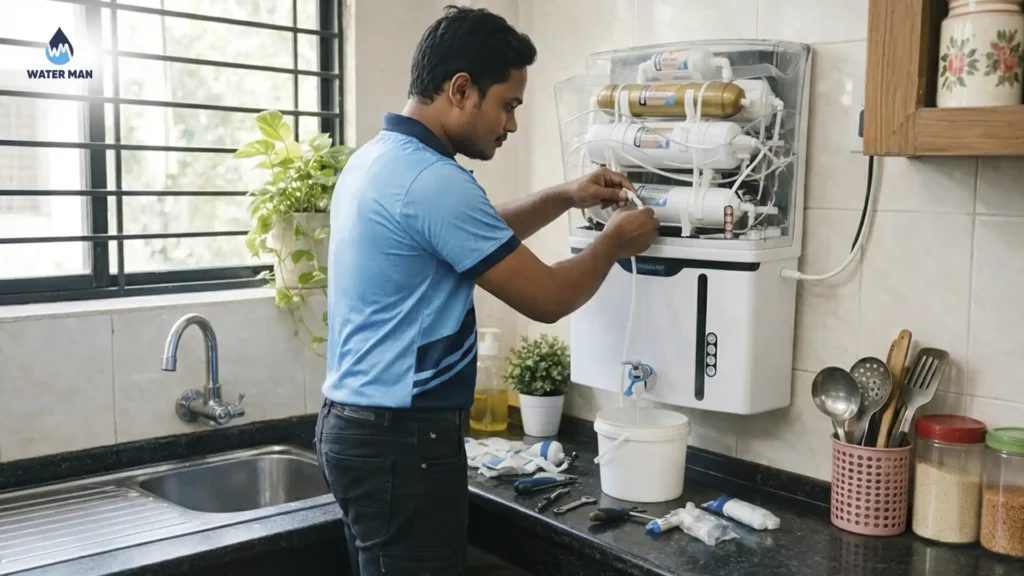
Service and Maintenance for Zen Aqua Water Purifiers in Bangladesh
Regular servicing is essential to keep your Zen Aqua water purifier working properly and maintain consistent water quality. Filter replacement, system cleaning and routine performance checks help ensure the purifier continues to meet your household’s drinking water needs.
For reliable support, choose an authorised service provider familiar with Zen Aqua water purifiers. Professional servicing can help identify potential issues, recommend suitable replacement filters and keep the system in good working condition.
If you’re looking for Zen Aqua water purifier service and maintenance in Bangladesh, Waterman BD can help you explore water purifier servicing, filter replacement and maintenance solutions based on your system’s requirements. Before arranging a service, confirm the provider’s authorisation status for your specific Zen Aqua model.
Frequently Asked Questions
1. What is the capacity of the Zen Aqua water purifier?
The supplied specifications state a production capacity of 100 GPD, approximately 15 litres per hour, and a maximum reserve tank capacity of 12 litres. Actual output depends on operating conditions and water quality.
2. How many purification stages does the Zen Aqua purifier have?
The specified system has nine stages: outer PP, inline sediment, inline post-carbon, RO membrane, UV, UF, Zinc, Copper and Alkaline filtration.
3. What is the difference between Zen Aqua Grand+ and Zen Aqua Smart?
According to the specifications provided for this guide, the purification system and capacity are the same. The models differ in external design, with Black and White appearance options.
4. Is the Zen Aqua water purifier suitable for home use?
The product information lists it for family use, with stated suitability for 1–12 persons. Actual suitability depends on household consumption, source-water quality, installation conditions and maintenance.
5. Does the Zen Aqua purifier remove every type of contaminant?
No water purifier should be assumed to remove every possible contaminant. Performance depends on the treatment components, source water, installation and maintenance. If a particular contaminant is a concern, test the water and verify that the system is certified or documented to address it.
6. How often should the filters be replaced?
Filter replacement frequency depends on water quality, usage and the manufacturer’s recommendations. Regular RO filter servicing in Dhaka can help assess filter condition and determine when replacement is needed.
7. How can I choose between the Black and White versions?
Choose the color and external design that best suit your installation area. Confirm the exact model and color availability before placing an order.
Choose the Right Zen Aqua Water Purifier for Your Home
The Zen Aqua Grand+ and Zen Aqua Smart offer a specified nine-stage configuration combining RO, UV, UF, Zinc, Copper and Alkaline filtration, with a stated 100 GPD production capacity and 12-litre maximum reserve tank.
Before choosing a model, consider your household’s daily water demand, source-water quality, installation requirements and access to routine maintenance. These factors are more useful for assessing suitability than the number of filtration stages alone.
If you are considering a Zen Aqua water purifier in Bangladesh, review the product specifications, confirm the model and colour you prefer, and ask for guidance on installation and maintenance requirements. A properly selected and maintained system can help support a practical household water-treatment routine.
Ready to explore the Zen Aqua range? Contact the product team to confirm model availability, specifications, installation requirements and after-sales support before ordering.