Every Flat Has Iron Water. Is Your Building Treating the Source or Just the Symptoms?
Full Building Iron Removal Water Treatment Plant: Imagine a 10-storey apartment building in Narayanganj with 40 families. Residents complain about orange stains on bathroom tiles, reddish deposits inside overhead tanks and discoloured water from their taps.
The management committee tries different solutions. Some residents install individual filters, the plumber checks the pipes, and the overhead tank is cleaned. But after a few months, the same complaints return.
Why? Because the problem is not limited to individual taps. The incoming water supply itself may contain excessive iron.
This is a common challenge for groundwater-dependent residential and commercial buildings in Bangladesh. A domestic purifier can treat water at a particular outlet, but it cannot address iron entering the building’s entire plumbing and storage system.
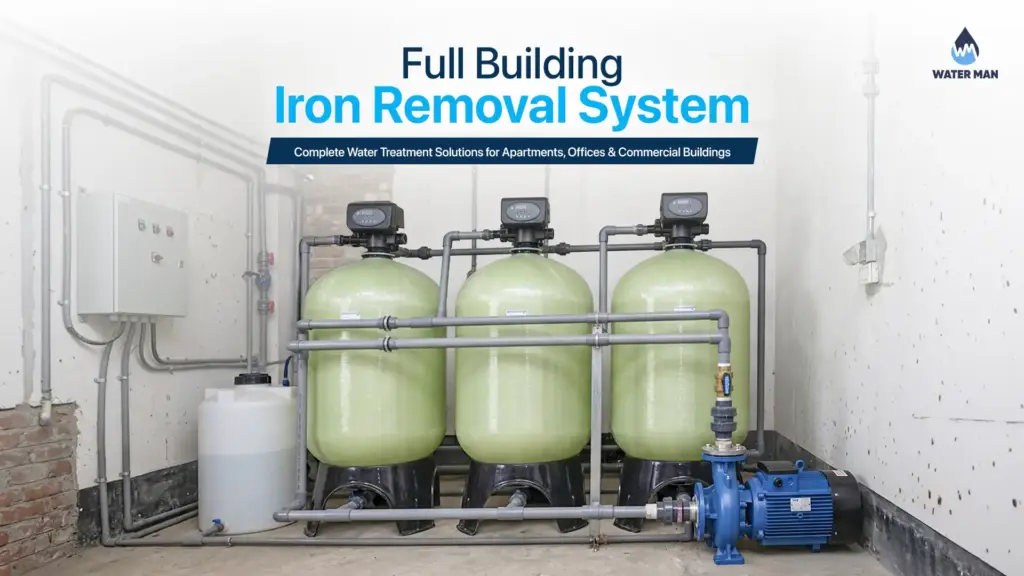
That is where a Full Building Iron Removal Water Treatment Plant becomes relevant. Installed at the main water entry point, a centralized system treats incoming water before it reaches the building’s storage tanks and distribution network.
Waterman BD provides water treatment solutions for residential apartments, commercial buildings and industrial facilities. This guide explains how a building iron removal plant works, what affects its price, and how to select a suitable system for your property.
What Is a Full Building Iron Removal Water Treatment Plant?
A full building iron removal water treatment plant is a centralised treatment system installed where water enters a building. It is designed to reduce iron in the incoming supply before distribution to flats, offices, storage tanks and other outlets.
Unlike individual point-of-use filters, which treat water at selected taps, a building-level iron removal system handles a much larger water supply.
A properly selected system can help:
- Reduce iron entering the building’s storage tanks and plumbing network.
- Minimise iron-related staining and sediment accumulation.
- Supply treated water to multiple floors and outlets.
- Simplify maintenance through one central installation.
- Reduce the need for separate iron removal arrangements in individual flats.
The actual treatment result depends on source-water quality, system design, correct sizing and regular maintenance.
Why Do Buildings in Bangladesh Need Centralized Iron Removal?
Many buildings in Bangladesh depend on groundwater from deep tubewells. Depending on the location and aquifer, this water may contain elevated iron concentrations.
Areas including Narayanganj, Gazipur, Bogura, Sirajganj, Mymensingh and parts of Dhaka may experience iron-related water quality problems. However, water testing is necessary to identify the actual condition of any particular building.
Iron-rich water can create several practical problems:
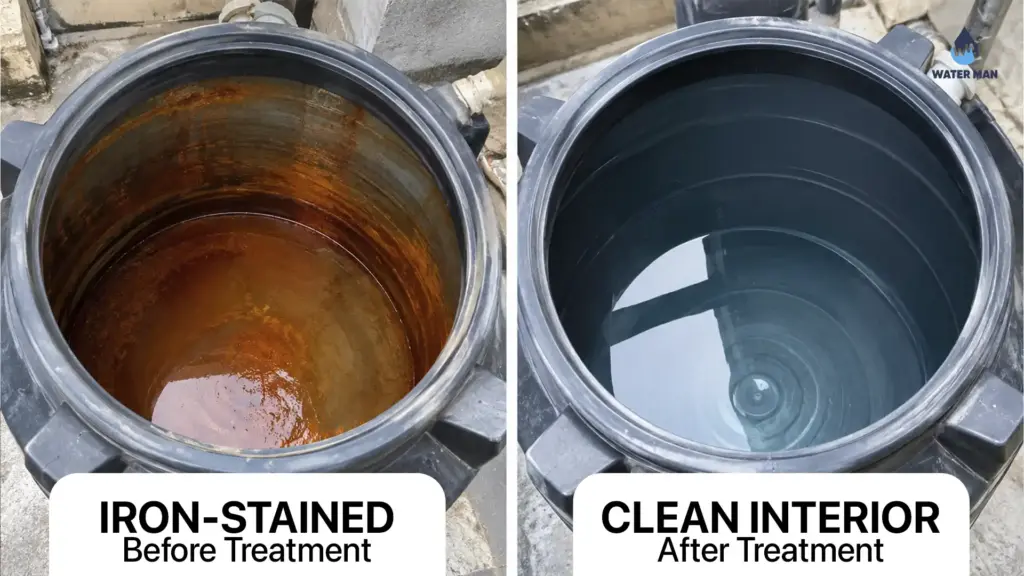
1. Overhead tank contamination: Iron deposits may accumulate inside storage tanks, creating reddish stains and sediment.
2. Plumbing maintenance: Continuous iron deposits can contribute to scale accumulation, restricted flow and additional maintenance requirements.
3. Bathroom and kitchen staining: Sinks, tiles, fixtures and other water-contact surfaces may develop orange or brown marks.
4. Commercial water requirements: Hotels, restaurants, offices and factories may need a treatment arrangement designed around their specific water consumption and operational requirements.
For larger properties, treating water at the main entry point is worth considering because it addresses the source before water reaches different parts of the building.
How Does a Building Iron Removal Water Treatment Plant Work?
The treatment process depends on the source water and required output quality. A typical system may include the following stages:
1. Raw Water Intake and Aeration
Water enters the plant from the building’s tubewell or other supply connection. Aeration introduces oxygen into the water, helping convert dissolved ferrous iron into ferric particles that can be captured through filtration.
Spray aeration, Venturi injection or cascade aeration may be used depending on the project.
2. Retention and Pressure Sand Filtration
After aeration, a retention stage may provide additional contact time for oxidation. Water then passes through a Pressure Sand Filter (PSF), where suspended particles and oxidised iron deposits can be captured by the filter media.
3. Iron-Specific Filter Media
For certain source-water conditions, additional media such as manganese greensand or manganese dioxide-based media may be required. The selection depends on iron concentration, pH, manganese and other water chemistry parameters.
4. Activated Carbon and UV Treatment
Activated carbon may be included when taste, odour or certain organic compounds need additional treatment. A UV unit may also be added where microbial disinfection is required.
These stages serve different purposes and should only be included when the water test and intended application justify them.
5. Treated Water Distribution and Backwashing
After treatment, water is delivered to the appropriate storage or distribution arrangement. Filter vessels also require periodic backwashing to remove accumulated particles and maintain performance.
Backwashing can be manual or automatic, depending on the plant configuration.
Key Benefits of a Full Building Iron Removal Plant
For building owners and management committees, centralised treatment offers a more organised way to manage water quality.
- Building-wide treatment: One central system can serve multiple flats and outlets.
- Reduced iron-related staining: Properly treated water can help minimise reddish deposits on tanks, sinks and bathroom fixtures.
- Better maintenance coordination: Instead of managing many separate filters, building management can coordinate maintenance for one main plant.
- Plumbing protection: Removing iron before distribution can help reduce iron deposits throughout the building’s water network.
- Commercial suitability: Treatment capacity can be planned around the requirements of offices, hotels and other commercial properties.
For residents, the main advantage is having a centrally managed water treatment arrangement rather than relying on separate equipment in every flat.
Centralised Iron Removal Plant vs Individual Flat Filters
| Comparison | Individual Flat Filters | Centralised Plant |
| Treatment location | Individual outlets | Main water entry |
| Coverage | Selected flats or taps | Multiple flats and outlets |
| Overhead tank treatment | No | Yes, when correctly installed |
| Maintenance | Multiple service schedules | Centralised maintenance |
| Building-level water management | Limited | Easier to coordinate |
| Installation | Separate units | One main installation |
For a building with many flats, centralised treatment can be easier to manage. However, the decision should consider the source-water condition, required flow rate, installation space and project budget.
Full Building Iron Removal Plant Price in Bangladesh (2026)
The water treatment plant price in Bangladesh depends on the building’s water demand, iron concentration, treatment stages, filter media and installation requirements.
The following are indicative price ranges from the project guide.
Residential Apartment Building
| Building Scale | Flow Capacity | Configuration | Estimated Price |
| 8–20 units | 1,000–2,000 L/hr | Aeration + PSF + UV | ৳1,20,000–৳2,80,000 |
| 20–50 units | 2,000–5,000 L/hr | Aeration + PSF + Greensand + UV | ৳2,50,000–৳5,50,000 |
| 50–100 units | 5,000–10,000 L/hr | vessel + Aeration + UV + Carbon | ৳5,00,000–৳12,00,000 |
| 100–300 units | 10,000–25,000 L/hr | Multi-stage engineering plant | ৳10,00,000–৳30,00,000 |
Commercial Buildings
| Building Type | Flow Capacity | Estimated Price |
| Office Tower | 2,000–8,000 L/hr | ৳3,00,000–৳10,00,000 |
| Hotel / Resort | 3,000–15,000 L/hr | ৳4,00,000–৳18,00,000 |
| Shopping Mall | 8,000–30,000 L/hr | ৳8,00,000–৳35,00,000 |
| Mixed-Use Development | 20,000–50,000 L/hr | ৳20,00,000–৳80,00,000+ |
Annual Maintenance Contract (AMC)
| System Scale | Annual AMC Estimate |
| Small building | ৳35,000–৳70,000 |
| Medium building | ৳60,000–৳1,20,000 |
| Large building / Commercial | ৳1,00,000–৳3,00,000 |
Prices are indicative estimates. Final quotations depend on water quality, required capacity, equipment configuration, site conditions and installation requirements.
How to Choose the Right Building Iron Removal Plant
Before purchasing an iron removal system, building owners should consider a few essential factors.
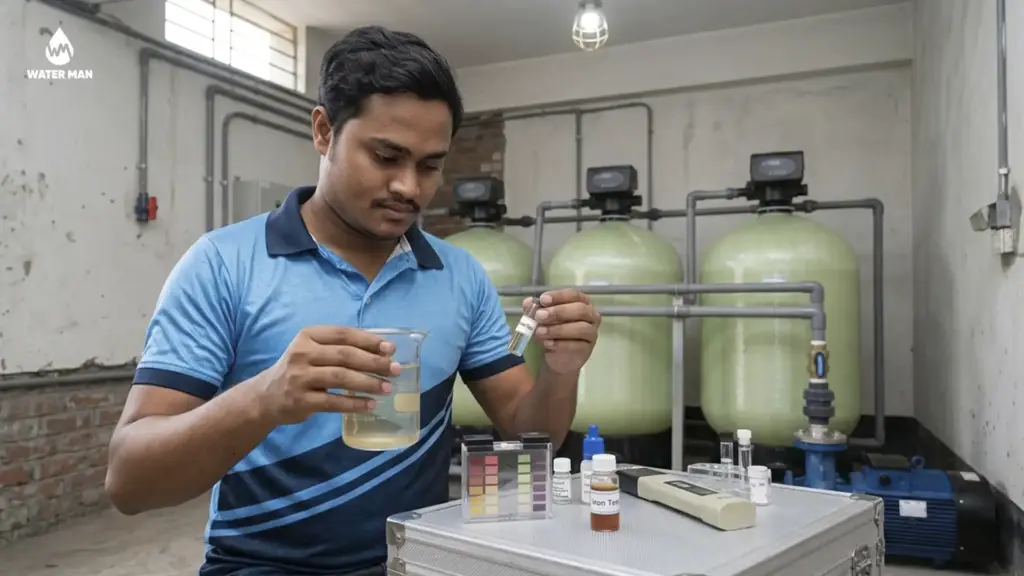
Water quality testing: Test iron, pH, manganese, TDS, hardness and turbidity. The results help determine which treatment stages are required.
Daily and peak water demand: Calculate how much water the building consumes, especially during busy morning hours. A system should be sized for the actual demand rather than average consumption alone.
Filter configuration: Low, moderate and high iron concentrations may require different treatment arrangements. There is no single configuration suitable for every source.
Installation space: Check pump room dimensions, drainage, electrical supply and access for future servicing.
Backwash arrangement: Manual backwash may suit smaller systems with reliable staff supervision. Automatic backwash can make operation more convenient for larger installations.
Supplier and after-sales support: Consider whether the supplier can provide system design, installation, commissioning, maintenance guidance and replacement parts.
Waterman BD can help assess project requirements and identify suitable water treatment solutions based on the building’s water quality and capacity needs.
Maintenance Tips for Building Iron Removal Plants
Regular maintenance is essential for keeping a centralised water treatment system operating properly.
- Follow the backwash schedule: Remove accumulated particles from filter media at the recommended intervals.
- Inspect iron removal media: Follow the manufacturer’s instructions for regeneration and replacement.
- Check UV equipment: If UV disinfection is installed, inspect and replace lamps according to the manufacturer’s recommended service interval.
- Monitor treated water: Periodically test output water for iron and other relevant parameters.
- Inspect pumps and valves: Check for leaks, unusual noise, pressure changes and reduced flow.
- Service the aeration system: Inspect nozzles and related components for deposits.
- Plan professional maintenance: Arrange periodic inspections and necessary media or equipment servicing.
A planned maintenance arrangement helps building management identify performance issues before they become major problems.
Common Mistakes to Avoid
Choosing equipment without testing water: Different water sources have different iron concentrations and chemistry. Test first.
Undersizing the plant: Average consumption may not represent peak demand. Calculate the required flow rate properly.
Ignoring installation space: Drainage, electrical connections and equipment access should be checked before installation.
Skipping backwashing: Poor maintenance can reduce filter performance and increase operating problems.
Assuming clear water means safe water: Appearance alone cannot confirm that iron or microbial contamination has been adequately addressed. Appropriate water testing is necessary.
Final Verdict: Invest in the Right Building Water Treatment Solution
A full building iron removal water treatment plant can be an important part of water infrastructure for apartments, offices, hotels and commercial properties dealing with iron-contaminated groundwater.
The right system should be selected according to actual water test results, building demand, treatment requirements and available installation space. A properly planned centralized solution can make water quality management easier and help reduce recurring iron-related maintenance issues.
Waterman BD provides water treatment solutions for residential, commercial and industrial applications across Bangladesh. From water quality assessment to system selection and after-sales support, the focus is on finding a suitable solution for each project’s requirements.
Contact Waterman BD for Your Building Iron Removal Plant
Share your building location, water source, approximate number of flats and existing water problems to discuss a suitable iron removal solution.