
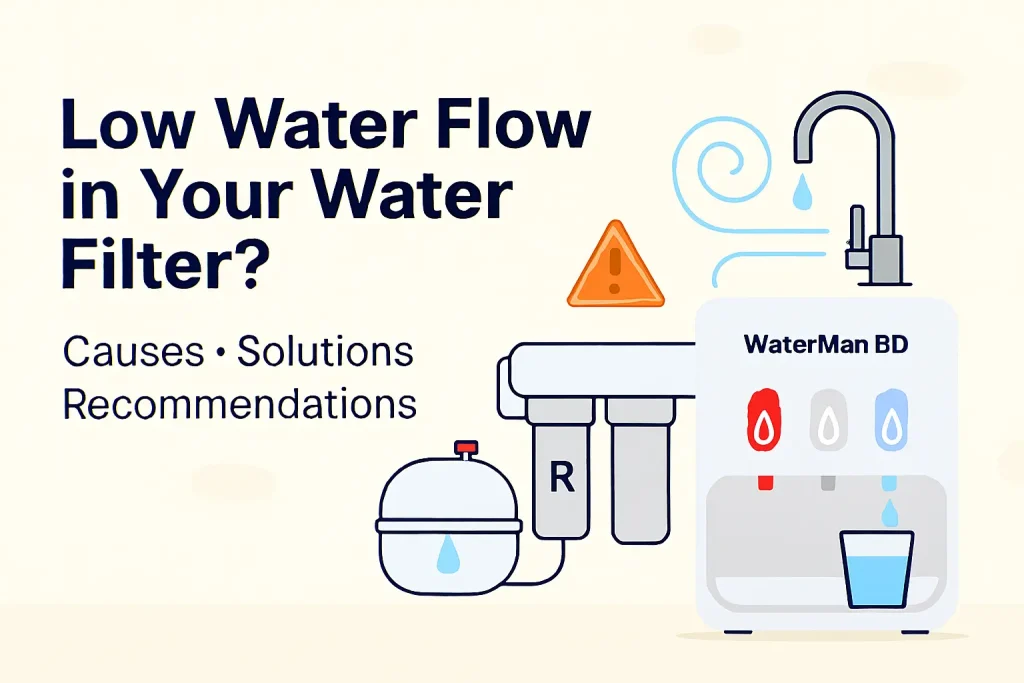
When your filter suddenly stops delivering optimal water flow, it disrupts everything – cooking, drinking, and everyday use. This issue can be caused by simple filter clogging or by deeper system problems such as membrane fouling or tank pressure failure.
To make your life easier, here’s a complete breakdown of why this happens, how to fix it, and what to do to prevent it.
Main Causes of Low Water Flow in Water Filters
1. Clogged Pre-Filters (Sediment/Carbon)
The sediment or carbon filter often gets filled with dirt, rust, silt, or chlorine particles. Once clogged, it restricts water from reaching the next stages.
2. RO Membrane Fouling or Scaling
Over time, minerals (calcium, magnesium), iron, or organic particles stick to the membrane. This blocks the pores and reduces flow drastically.
3. Partially Closed Valves or Blocked Inlet Line
Sometimes the inlet valve isn’t fully open or the feed pipe has dirt buildup, reducing supply flow.
4. Low Water Pressure from the Main Supply
RO systems require 15–30 psi (1–2 bar) for efficient filtration. If the supply pressure is low, the RO can’t push water through the membrane properly.
5. Storage Tank Pressure Problems
If the tank’s internal bladder loses pressure, water cannot flow out smoothly. A failing tank can reduce flow to less than half.
6. Flow Restrictor, Faucet, or Tubing Blockage
Debris in the faucet aerator, damaged flow restrictor, or kinked tubing can also reduce output.
Step-by-Step Troubleshooting (DIY Checklist)
1. Check the Pre-Filters
Open the housing and see if the filters look dirty, brown, black, or slimy. Replace if blocked.
2. Ensure the Inlet Valve Is Fully Open
Sometimes the simplest things cause the biggest problems. Make sure the supply valve isn’t partially closed.
3. Test Water Pressure
If the house water pressure is low, the RO will struggle. You may need a booster pump.
4. Check the Storage Tank Pressure
Empty the tank → measure pressure at the air valve → should be around 5–7 psi.
If low, add air with a pump.
5. Inspect the Faucet & Flow Restrictor
Remove faucet aerator → clean debris.
Check the restrictor in the drain line – replace if clogged.
6. Evaluate the RO Membrane
If membranes are older than 12–24 months or visibly dirty, flow naturally reduces. Replace or chemically clean (only through trained technicians).
Solutions Based on the Problem
1) For Clogged Pre-Filters
Replace sediment + carbon filters every 3–6 months (water quality dependent).
2) For Membrane Fouling/Scaling
Membrane chemical cleaning or replacement.
Use an anti-scalant for high-TDS water (for commercial/industrial RO).
3) For Low Supply Pressure
Install a booster pump.
Check for plumbing issues or weakened supply lines.
4) For Tank Pressure Issues
Re-pressurize the tank or replace it if the bladder is damaged.
5) For Flow Restrictor or Faucet Blockage
Clean or replace the restrictor.
Clean faucet aerator with vinegar solution.
Preventive Maintenance Plan (Simple & Effective)
Every 3–6 months
Replace pre-filters
Inspect tubing and fittings
Every 12–24 months
Replace or clean RO membrane
Check tank bladder pressure
Yearly
Full system inspection
Sanitization and leak check
Anytime the flow drops more than 50%
- Immediate technician check-up
When You Should NOT Try Fixing It Yourself
- Membrane replacement or cleaning
- Pump installation
- Tank bladder replacement
- Electrical repairs
These require trained RO technicians.
FAQ
Q1: What is the most common reason for low water flow in RO?
A: A clogged sediment or carbon filter is the number one cause.
Q2: Why does my RO work slowly after a few months?
A: Membrane fouling, scaling, or pre-filter clogging reduces speed.
Q3: What should the tank pressure be?
A: Ideally 5–7 psi when empty.
Q4: Does low supply pressure affect RO flow?
A: Yes, RO systems require minimum pressure to push water through the membrane.
Professional Recommendations
- Always maintain a service schedule and reminders every 2 – 3 months.
- Keep in contact with a consistent supplier and after-sales service provider, or extra pre-filters in stock.
- Use a pre-sediment filter if your area has muddy/dirty water.
- Use a professional and trained technician’s help on proper membrane care and cleaning.