Introduction: Why Water Management Is Critical for Auto Rice Mills
Automatic rice mills are the backbone of Bangladesh’s food supply chain. They ensure higher productivity, better grain quality, and reduced labor dependency. However, one hidden but critical factor behind efficient rice milling is water — both in terms of quantity used and quality managed.
From paddy soaking and washing to boiler feed water and floor cleaning, rice mills consume a significant amount of water daily. Without proper treatment and management, this water becomes polluted wastewater that can seriously harm nearby canals, farmland, and groundwater.
This is why Water Treatment Plants (WTPs) and Effluent Treatment Plants (ETPs) for Rice Mills are no longer optional — they are essential for sustainable rice mill operations in Bangladesh.
Water Use in Automatic Rice Processing (Very Important to Understand)
Before discussing treatment, it’s important to understand where and how water is used inside an automatic rice mill.
Main Water Consumption Areas in Rice Mills
Paddy Washing
Raw paddy often arrives with:
- Dust
- Mud
- Sand
- Agricultural residues
Water is used to wash paddy before soaking or milling. This generates high suspended solid wastewater.
Paddy Soaking & Parboiling (If Applicable)
In parboiled rice mills:
- Hot soaking water absorbs starch and organic matter
- Generates high BOD wastewater treatment challenges
- Creates odor if untreated
This is a major source of Parboiled Rice Wastewater Treatment demand.
Boiler & Steam Generation
Boiler feed water must be treated to prevent:
- Boiler scaling
- Corrosion
- Fuel wastage
- Tube damage
This requires proper Boiler Feed Water Treatment Rice Mill systems.
Equipment & Floor Cleaning
Daily cleaning uses large volumes of water mixed with:
- Rice husk dust
- Broken rice
- Oil and grease from machinery
This contributes to the wastewater load.
Domestic Use
Water is also used for:
- Workers’ washing
- Toilets
- Canteens
How Much Water Does a Rice Mill Use? (Approximate)
Although exact consumption depends on mill size and process type:
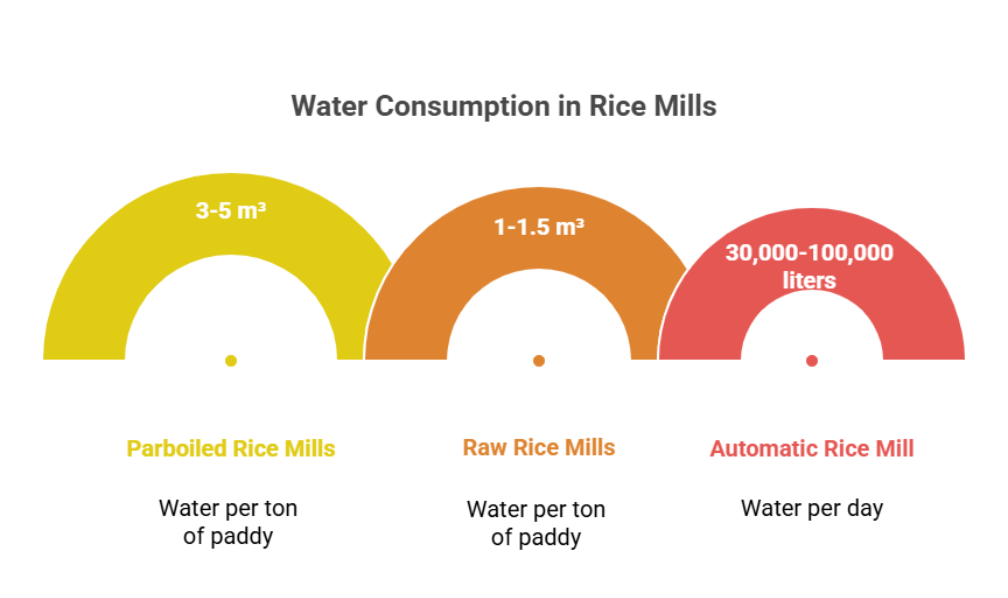
- Raw rice mills: ~1–1.5 m³ water per ton of paddy (may vary)
- Parboiled rice mills: ~3–5 m³ water per ton of paddy (may vary)
That means a medium-scale automatic rice mill can consume 30,000–100,000 liters/day.
Without treatment, this entire volume becomes wastewater.
Water Treatment Plant (WTP) and Effluent Treatment Plant (ETP) for Rice Mills
A Water Treatment Plant (WTP) for rice mills performs two key functions:
A) Incoming Water Treatment
So it is suitable for:
- Paddy washing
- Boiler feed
- Equipment cleaning
This typically includes:
- Sand filtration
- Carbon filtration
- Water softening or RO (if needed)
B) Rice Mill Effluent Treatment (ETP)
An Effluent Treatment Plant (ETP) for Rice Mill treats wastewater to:
- Reduce BOD & COD
- Remove suspended solids
- Enable safe discharge
- Allow water reuse
This is central to Rice Mill Wastewater Management in Bangladesh.
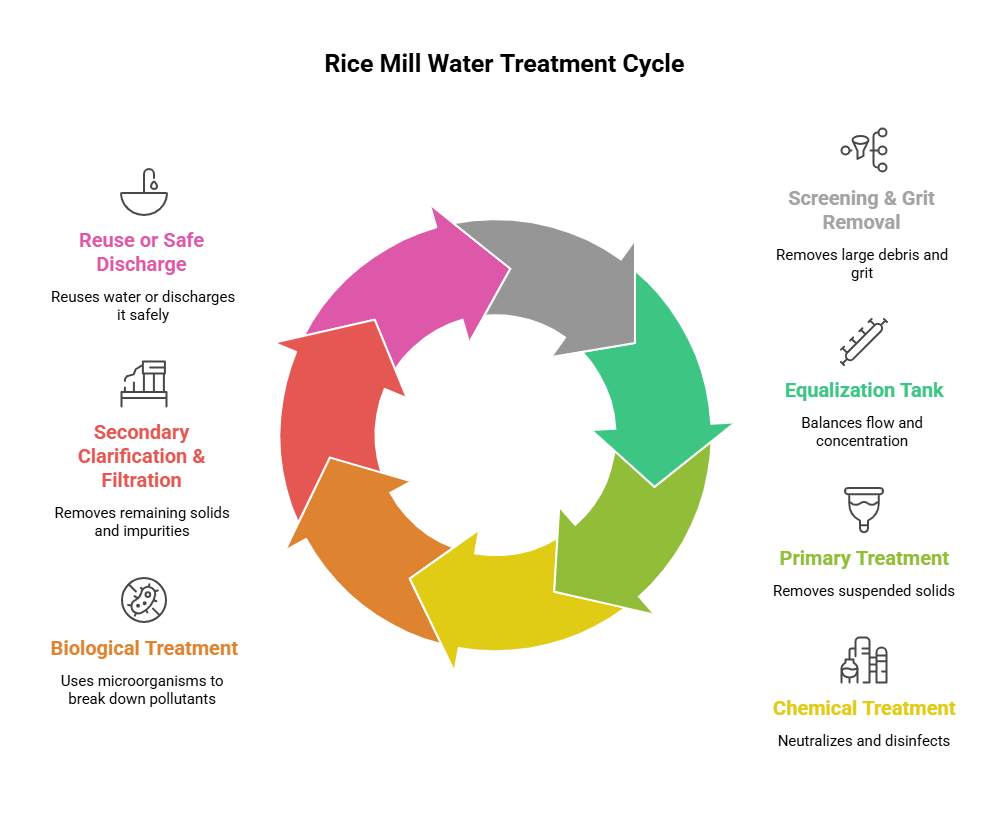
How Water Treatment Plants Work in Rice Mills (Step by Step)
Step 1: Screening & Grit Removal
- Removes husk particles, sand, and large debris
- Protects pumps and pipelines
Step 2: Equalization Tank
- Collects all wastewater
- Maintains uniform flow and pollution load
Very important for mills with fluctuating operations.
Step 3: Primary Treatment
- Sedimentation tanks allow heavy solids to settle
- Oil & grease traps remove floating materials
Step 4: Chemical Treatment
- Coagulants & flocculants bind fine particles
- Reduces turbidity and color
Step 5: Biological Treatment for Rice Effluent
Microorganisms break down:
- Organic matter
- Starch residues
- High BOD & COD loads
Critical for parboiled rice wastewater treatment.
Step 6: Secondary Clarification & Filtration
- Final settling
- Sand or pressure filters for polishing
Step 7: Reuse or Safe Discharge
Treated water can be reused for:
- Floor cleaning
- Gardening
- Cooling systems
Reduces groundwater extraction significantly.
Advantages of Water Treatment in Rice Mills
✔ Water Reuse & Cost Reduction
Up to 40–60% of treated water can be reused, reducing:
- Groundwater extraction
- Monthly water bills
✔ Boiler Efficiency Improvement
Treated feed water:
- Prevents scale formation
- Reduces fuel consumption
- Extends boiler life
✔ Environmental Protection
Prevents pollution of:
- Canals
- Rivers
- Agricultural land
- Tube-well groundwater
✔ Regulatory Compliance
Avoid:
- Government penalties
- Community complaints
- Forced shutdown
Supports a Sustainable Rice Industry Bangladesh model.
Disadvantages & Practical Challenges
- High initial installation cost
- Need for trained operators
- Regular chemical & maintenance expenses
- Sludge disposal management
However, these challenges are far less costly than environmental damage or legal action.
Bangladesh-Specific Groundwater & Coastal Challenges
In Bangladesh:
- Iron: 1–5 ppm common
- Hardness: Above safe boiler limits
- TDS: High in Khulna, Barishal, Satkhira, Noakhali
Untreated discharge contributes to:
- Environmental impact of untreated rice mill wastewater Bangladesh
- Canal contamination
- Soil degradation
This makes Water treatment plants for automatic rice mills in Bangladesh urgent.
Choosing the Right Water Treatment Solution for Your Rice Mill
Small Mills
✔ Basic screening
✔ Sedimentation
✔ Simple biological treatment
Medium to Large Auto Rice Mills
✔ Full ETP with chemical + biological treatment
✔ Boiler feed water treatment
✔ Partial water reuse system
Multi-Stage Water Treatment Systems (Recommended)
- ✔ IRP + Softener + RO
✔ Softener + DM for boilers - Best practice for Automatic Rice Mill Water Management.
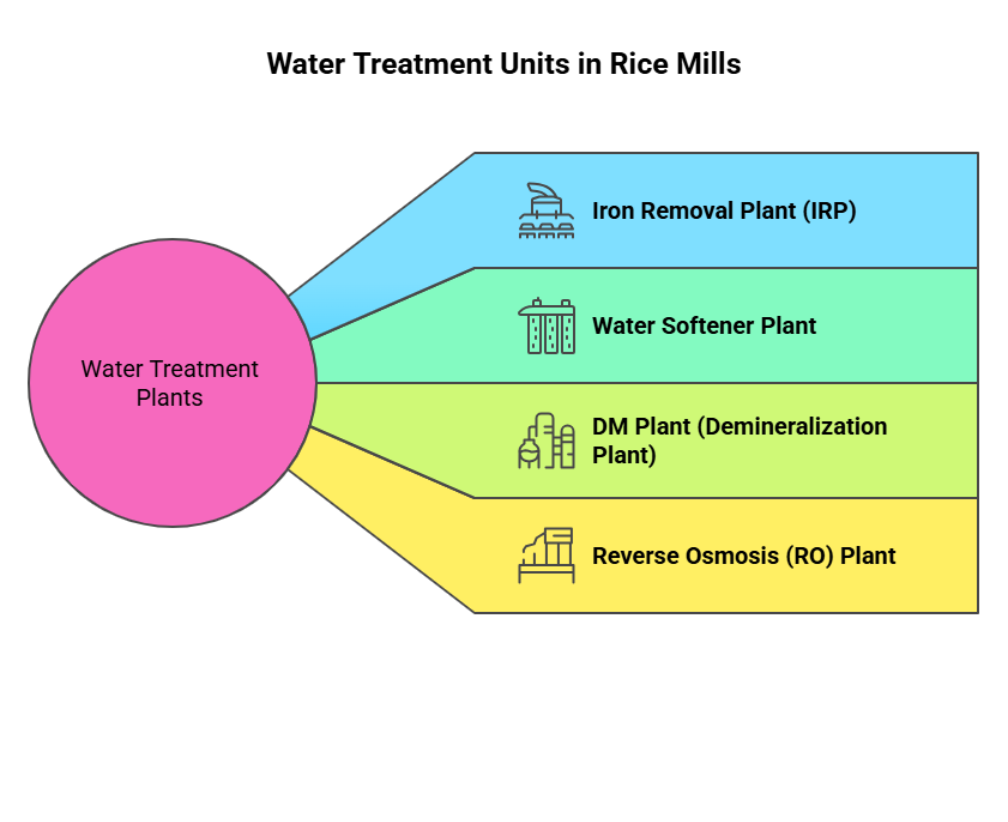
Key Water Treatment Units Used in Automatic Rice Mills
In Bangladesh, most rice mills depend on groundwater, which often contains iron, hardness, dissolved salts, and contaminants. If untreated, these damages boilers, stain rice, reduce machine life, and increase fuel and maintenance costs. That’s why modern rice mills use specific treatment systems before water enters production.
Let’s understand the four most important treatment plants used in rice mill operations.
1. Iron Removal Plant (IRP)
Why It’s Needed in Rice Mills
Groundwater in many areas of Bangladesh (especially Dhaka outskirts, Rajshahi, Jessore, Faridpur, Rangpur, Khulna belt) contains high iron (Fe²⁺). Iron causes:
- Brown/red stains on rice
- Bad odor in water
- Scaling in boilers
- Choking of pipelines and nozzles
How It Works (Simple Explanation)
- Oxidation: Iron is converted from soluble to insoluble form using air or chemicals.
- Filtration: Iron particles are trapped in special filter media.
- Backwashing: The system cleans itself periodically.
Where Used in Rice Mills
- Paddy washing
- Boiler feed pre-treatment
- Equipment cleaning
Advantages
- Improves rice appearance
- Protects boiler & pipelines
- Low operating cost
Limitations
- Does not remove hardness or TDS
- Needs regular backwash
Iron Removal Plant delivers clean, iron-free water for residential, commercial, and industrial use
2. Water Softener Plant
Why It’s Needed
Bangladesh groundwater often has high hardness (calcium & magnesium), which causes:
- Boiler scaling
- Heat loss
- Increased fuel consumption
- Frequent breakdowns
How It Works
Water Softener Treatment Plant uses ion exchange resin to replace calcium and magnesium ions with sodium ions, preventing scale formation.
Where Used
- Boiler feed water
- Steam generation units
- Cooling systems
Advantages
- Extends boiler life
- Improves heat transfer efficiency
- Reduces chemical cleaning costs
Limitations
- Requires salt regeneration
- Not suitable for drinking water
- Does not remove TDS or microbes
3. DM Plant (Demineralization Plant)
Why It’s Needed
For high-pressure boilers used in parboiled rice mills, even small dissolved salts can cause:
- Tube corrosion
- Scaling
- Boiler shutdowns
DM plants remove almost all dissolved minerals, producing ultra-pure water.
How It Works
- Cation exchanger removes positive ions (Ca²⁺, Mg²⁺, Na⁺).
- Anion exchanger removes negative ions (Cl⁻, SO₄²⁻, HCO₃⁻).
- Sometimes followed by a mixed-bed polisher for high purity.
Where Used
- High-pressure boilers
- Sensitive steam systems
Advantages
- Produces very low TDS water (<10 ppm)
- Prevents corrosion & scaling
- Ideal for industrial steam systems
Limitations
- Higher capital and chemical cost
- Requires skilled operation
- Produces chemical waste during regeneration
4. Reverse Osmosis (RO) Plant
Why It’s Needed
In coastal and semi-coastal areas of Bangladesh, groundwater often contains:
- High TDS
- Salinity
- Heavy metals
RO Plant removes 95–99% of dissolved salts and contaminants, making it suitable for both processing and reuse.
How It Works
Water is pushed through a semi-permeable membrane that allows only pure water molecules to pass, rejecting salts, metals, bacteria, and viruses.
Where Used
- Boiler feed after softener
- Paddy washing where the water quality is poor
- Reuse of treated wastewater
Advantages
- Removes TDS, salinity, and microbes
- Improves rice quality
- Enables water recycling
Limitations
- Higher energy cost
- Reject water generation (30–50%)
- Requires skilled maintenance
Conclusion: Invest in Sustainable Water Management Today
A properly designed Water Treatment Plant for Rice Mills ensures:
- Lower operating cost
- Environmental compliance
- Better rice quality
- Long-term sustainability
For Bangladesh, protecting water resources means protecting agriculture, food security, and business continuity.Investing in proper water treatment today means protecting both your business and Bangladesh’s future water resources.